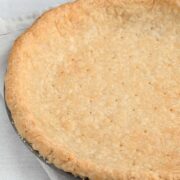
Vegan Flaky Pie Crust
Try this dairy-free flaky pie crust recipe to make your desserts stand out. This versatile dough is also perfect for savory fillings.
Equipment
- Mixing bowls
- Rolling Pin
- 8 or 9 inch Pie Plate
Ingredients
- 1 ¾ cup (200 g) all-purpose flour spooned and levelled
- ¼ cup (57 g) vegan butter stick or margarine (not unsalted) cubed and frozen
- ¼ cup (57 g) butter-flavoured vegetable shortening cubed and frozen
- ¼ teaspoon salt
- 2 teaspoon ( 10 ml) lemon juice (or vinegar, or vodka)
- 4 tbsp (60 ml) water ice cold
Instructions
Make the dough:
- Combine the flour, salt, vegan butter and shortening in a large bowl.1 ¾ cup all-purpose flour, ¼ cup vegan butter stick or margarine (not unsalted), ¼ cup butter-flavoured vegetable shortening, ¼ teaspoon salt
- Using a pastry blender or a knife, cut any large pieces into smaller penny-sized chunks.
- Add the lemon juice to the ice water and gradually add the liquid to the flour. Add 1 tablespoon at a time, stirring with a palette knife or fork after each addition until the dough begins to stick together.2 teaspoon lemon juice, 4 tbsp water
- Shape the dough into a ball with your hands.
- Flour a clean work surface or sheet of parchment paper and a rolling pin. Roll out the dough to a rectangular shape.
- Fold the left and the right ends of the dough towards the centre, then fold the ends of the dough together.
- Make a quarter turn with the dough and then roll out once more to a rectangular shape.
- Repeat the folding step then wrap with cling film. Chill the dough for at least 2 hours in the refrigerator or 1 hour in the freezer to solidify the butter and shortening.
Line the pie plate:
- Roll out the dough to an ⅛ -inch (3mm) thickness on the floured surface or paper.
- Lift the dough using the rolling pin and place it in a 9-inch (23cm) pie dish.
- Trim the dough ½-inch (1cm) over the rim of the pie dish. Roll and tuck the edges under. You may also make a fluted design or crimp the edges.
- Prick the dough with a fork and refrigerate for at least 2 hours or overnight, covered with plastic wrap.
- Use the pie dough as directed in a recipe or blind-bake following the steps below.
Blind-bake the pie shell:
- Place a rack in the middle of the oven and preheat to 400°F (200°C).
- Place the chilled, unbaked pie crust on a baking tray. Cover the crust with parchment paper or aluminum foil. Fill with your desired pie weights (I used granulated sugar).
- Bake for 30 minutes. Carefully remove the paper or foil with weights and set it aside to cool. For pies with no-bake fillings, return the crust to the oven and bake for another 15 minutes or until golden brown.
Notes
- Keeping the fats cold is crucial for the flakiest crusts. It helps to chill the flour, butter, mixing bowl and utensils in the freezer before working, especially if you'll be working in a warm environment
- You may not use all the liquid. Add just enough to moisten and shape the dough into a ball.
- Never stretch the dough when placing it in the pan. This can cause it to shrink in the pan while baking.
- Resting the dough in the fridge is important for chilling and solidifying the fats for a flakier crust and relaxing the proteins in the flour. As the dough is kneaded or rolled, more gluten develops and tightens. If it's not allowed some resting time, the crust will shrink and become tough when baked. Even if you decide to freeze the dough, be sure to refrigerate it for at least 2 hours before freezing.
- If the dough warms up any time while working, return it to the fridge for 30 minutes or freezer for 15 minutes.
- Pie crust dough can be refrigerated for up to three days and frozen for up to three months. Keep the dough in its original plastic wrap or place it into a freezer bag if you intend to use it at a later date.
- Vegan pie recipes for this flaky crust:
- This recipe makes enough for a single, regular (shallow) 8 or 9-inch pie crust.
- Make two times the recipe for a deep-dish pie or double-crust.
- Make two times the recipe for a double crust for a standard (shallow) pie pan.
- Make three times the recipe for a double crust for a deep-dish pie pan - use one batch for the top crust and two batches for the base.
Nutrition
Calories: 207kcal | Carbohydrates: 21g | Protein: 3g | Fat: 12g | Saturated Fat: 3g | Polyunsaturated Fat: 3g | Monounsaturated Fat: 5g | Trans Fat: 1g | Sodium: 141mg | Potassium: 34mg | Fiber: 1g | Sugar: 1g | Vitamin A: 254IU | Vitamin C: 1mg | Calcium: 7mg | Iron: 1mg